
The 2026 FIFA World Cup, co-hosted by the United States, Mexico, and Canada, is set to be football's largest tournament but will unfold against a backdrop of significant geopolitical tensions, including conflicts, strained alliances, and complex immigration policies, challenging its traditional role as a symbol of global unity.

Nobody takes Pakistan seriously and therefore Pakistan's sudden mediating with almost immediate results of a ceasefire seems more contrived than real, points out Vice Admiral Biswajit Dasgupta (retd).

Jewellers in Lucknow protest Prime Minister Modi's appeal to defer gold purchases for a year amid the West Asia crisis, fearing significant business losses and economic hardship for those involved in the trade.

Pakistan's Prime Minister Shehbaz Sharif has offered to mediate between the US and Iran to de-escalate the ongoing conflict in West Asia, following a joint US-Israel attack on Iran. Sharif has been in contact with Saudi Arabia, the UAE, and other nations to promote dialogue and diplomacy.

Fast-moving consumer goods (FMCG) companies like Dabur India and Marico anticipate high single-digit growth in Q4FY26, driven by strong domestic demand in India, which is helping to offset the negative impact of geopolitical conflicts in West Asia on their international businesses.

The signing of the US-Iran deal to end the conflict in West Asia has been delayed by a few hours due to Israel's strikes on Hezbollah targets in Beirut, US President Donald Trump told local media in Washington, DC.

Italy has denied the United States the use of the Sigonella military base for flights heading to West Asia, citing a lack of consultation and concerns over the nature of the flights. This decision reflects Italy's stance on avoiding escalation in the region, as Prime Minister Giorgia Meloni's government emphasises its desire to stay out of war.

Indian equity benchmark indices Sensex and Nifty experienced a significant tumble in early trade, with the Sensex tanking nearly 700 points, driven by uncertainty surrounding US-Iran negotiations, a fresh spike in crude oil prices, and persistent foreign fund outflows.

'India has initiated a bear market and we will still go lower. It has nothing to do with the economy.'

Reserve Bank of India (RBI) Governor Sanjay Malhotra stated that recent regulatory measures to address foreign exchange market volatility, such as capping banks' net open positions, are temporary and aligned with current market conditions, not signalling any structural shift in policy.
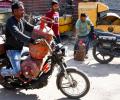
Mumbai police are investigating the theft of 27 LPG cylinders from a delivery vehicle in Kandivali, amid concerns about potential supply disruptions.

Dabur India's stock has fallen over 17 per cent since the start of the Iran war, driven by concerns over a weak monsoon, the West Asian crisis, and rising input costs, which are expected to impact the company's revenues and margins, particularly affecting its significant rural sales and international markets.

Top leaders from the US, Iran, and Pakistan, along with other nations, have gathered in Switzerland for high-level talks aimed at restoring peace in West Asia. These negotiations follow a recently signed Memorandum of Understanding between the US and Iran, initiating a 60-day window for a deal. Discussions focus on Iran's nuclear programme and the fragile interim peace deal, amidst renewed tensions and the fluctuating status of the Strait of Hormuz.

Reports are emerging that Ali Larijani, a key Iranian security official, was allegedly targetted in an Israeli airstrike, escalating tensions in the region.

India's foreign exchange reserves decreased by USD 11.413 billion to USD 698.346 billion during the week ending March 20, primarily due to a significant reduction in gold reserves, according to the Reserve Bank of India (RBI).
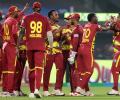
West Indies players are leaving India on commercial flights in batches after their departure was delayed due to international airspace closures amid ongoing conflict in the Middle East, the Caribbean side's governing body CWI said on Tuesday.

Indian companies, however, are now paying a premium of $6-$7 a barrel for Russian oil, compared with discounts of $8-$10 a barrel before the start of the conflict.
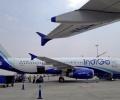
IndiGo airline will face near-term pressure on profitability from rising fuel prices following the escalation of conflict in West Asia, though it is likely to pass on higher costs to passengers over time because its ticket booking cycle is relatively short, according to a report by Moody's Ratings.
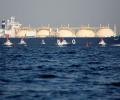
A Liquefied Natural Gas (LNG) carrier, chartered by an Indian firm, safely transited through the Strait of Hormuz -- the first Indian LNG tanker to cross the war-hit narrow shipping lane since the war in West Asia broke out more than three and a half months back.

'The West Asia or the Gulf crisis has shown that what we develop as national infrastructure when things are not as bad as they could be, we forget to plan for adversities.'

Head of the Iranian Parliament's National Security Committee Ebrahim Azizi on Saturday said that Iran has prepared a "professional mechanism" to regulate maritime traffic in the Strait of Hormuz through a designated route, which will be unveiled soon.
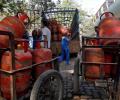
Domestic cooking gas (LPG) prices have increased by Rs 29 per cylinder, marking the second hike in three months due to rising global energy costs. This follows broader fuel price increases for petrol, diesel, and CNG, with state-owned retailers still incurring significant losses despite the revisions.


Indian equities are experiencing their sharpest rebound in years, with the BSE 500 index rallying 12.1 per cent so far this month, echoing Covid-era recoveries despite ongoing geopolitical uncertainty and earnings risks.

IDF chief stressed the urgent need for legislative measures, including a conscription law, a reserve duty law, and an extension of mandatory military service.

Benchmark equity indices Sensex and Nifty tumbled in early trade on Wednesday, tracking a bearish trend in Asian markets, as the conflict in West Asia widened, driving oil prices higher.

Prime Minister Narendra Modi urged US President Donald Trump to prioritise the safety of Indian seafarers in the Strait of Hormuz during the implementation of Washington's proposed Iran peace deal, as both leaders focused on repairing strained bilateral relations at the G7 summit.

Indian javelin throw superstar Neeraj Chopra would hope that his lengthy injury-forced absence from competition does not affect his rhythm when he returns to action against an in-form line-up of heavyweight rivals in the familiar environs of the Doha Diamond League on Friday.

Mojtaba Khamenei, son of Iran's Supreme Leader, is reportedly recovering from injuries sustained in an attack. Reports indicate he is participating in meetings and decision-making despite his condition.

Pakistan's Prime Minister Shehbaz Sharif has called for urgent de-escalation and dialogue in West Asia during a phone call with Iran's President Masoud Pezeshkian, expressing serious concern over ongoing hostilities.

Iran has reportedly allowed select "friendly nations" including India and Pakistan limited access to the Strait of Hormuz amid ongoing conflict, easing some energy supply concerns. Here's what the move means for global trade and oil routes.

United States President Donald Trump on Friday declared that there would be 'no deal with Iran except unconditional surrender' amid the escalating West Asia conflict, asserting that Tehran must capitulate before any diplomatic negotiations can proceed.

India is in communication with Iranian officials to ensure the safety and secure passage of its ships through the Strait of Hormuz, following recent firing incidents involving Indian vessels.

The Centre on Monday informed the Supreme Court that the Central Board of Secondary Examination has come up with a new policy for the evaluation of private students, who were affected by the cancellation of Class XII board examination in Gulf countries due to the recent Iran-US war.
Opposition MPs in the Rajya Sabha criticised the Modi government's economic policies, citing the LPG crisis, lack of energy security, and concerns over the Economic Stabilisation Fund.
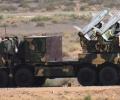
Indian defence stocks have seen an average year-on-year gain of 67 per cent, driven by renewed interest following 'Operation Sindoor' and a broader increase in global geopolitical tensions, with the combined market capitalisation of 18 firms increasing by approximately 2.3 trillion.

Indian stock markets are set to be influenced by ongoing developments in the US-Iran conflict, fluctuations in crude oil prices, and the latest quarterly earnings reports from major corporates, with foreign investor activity also playing a crucial role.

The United States and Iran could resume negotiations as early as next week in Islamabad, according to a report by The Wall Street Journal citing people familiar with the matter.

Iranian Foreign Minister Abbas Araghchi said his trip to Islamabad was "very productive" and involved "good consultations" with Pakistan's top leadership amid uncertainty over the second round of peace talks to resolve the war in West Asia.

Hours after ceasefire, US President Donald Trump on Wednesday warned against any country supplying military weapons to the Islamic Republic, stating that he would impose a 50 percent tariff on all goods exported to the United States.
